5 Common Desk Decor Mistakes That Kill Productivity
You can own an excellent chair, a monitor at the right height and a lamp that cost more than your kettle, then sit down and still find your attention sliding sideways within minutes. The hardware is rarely the problem. It is the arrangement around it: the objects, colours and light you have chosen to decorate with. Desk decor is not neutral. Everything on the surface either helps you settle into the work or quietly competes with it. Here are five of the most common mistakes, and what to do instead.
1. Turning the desk surface into a display shelf
Most desks start clear and slowly acquire residents. A figurine from a trip. A candle you never light. A jar of pens you don’t use because you type everything. A mug too nice to drink from. Each item is harmless on its own, but together they become a wall of small prompts. Every time your eye lands on something, it asks a question: is that pen empty, did I reply to that message, is that plant dying. The real cost is not mess. It is the tiny pull of attention, repeated all day.
The blank surface test
Stand up, step back a metre and look at the desk as a whole. Half-close your eyes. Whatever you notice first is what your eye notices the moment you sit down. Move those things off the desk, onto a wall shelf or into a drawer. Aim for more empty surface than occupied surface.
- Keep one or two objects you genuinely look at and enjoy.
- Group small items on a single tray instead of scattering them.
- Anything you have not touched in a month belongs in a drawer, not on display.
- Give the objects that stay a defined home, so they do not drift into the middle.
2. Choosing decor that hums in the background
A patterned desk mat, a glossy brass pen pot, a brightly striped plant pot: none of these will ruin your day, but they sit inside your field of vision for hours. Visual noise near the keyboard is the worst place for it, because that is the zone your eyes rest on between thoughts.
Keep the thirty centimetres around your keyboard and mouse quiet. Matte finishes, mid-tone or neutral colours, minimal pattern. Save the pattern and the saturated colour for things you deliberately look at, such as a framed print on the wall or a cushion on the chair. A low-contrast working zone also cuts glare from lamps and screens, which matters more than most people expect.
Glossy surfaces deserve a mention too. A glass pen pot, a shiny frame, a polished desk top — each one bounces light straight back at you. If you regularly find yourself tilting your screen away from a reflection, the decor is the culprit, not the screen.
3. Putting decor in the line of sight
The strip between your eyes and the monitor, roughly the width of the screen and a hand’s depth below it, should be treated as working space rather than display space. That is where a tall plant, a leaning picture frame or a lamp shade ends up level with your eyeline. Look behind the screen as well: a busy gallery wall, a cluttered shelf or a window onto a footpath all give your eyes somewhere to escape to when you pause to think.
Keep a clear band. Push decor to the sides, above head height, or onto a shelf behind you. If you like having something to rest your eyes on, choose one calm object — a single plant, a plain print, a window with a view — and leave the rest of the wall bare. If your desk faces a doorway, a corridor or a busy street, try angling it slightly rather than adding more objects to block the view.
4. Decorating the light
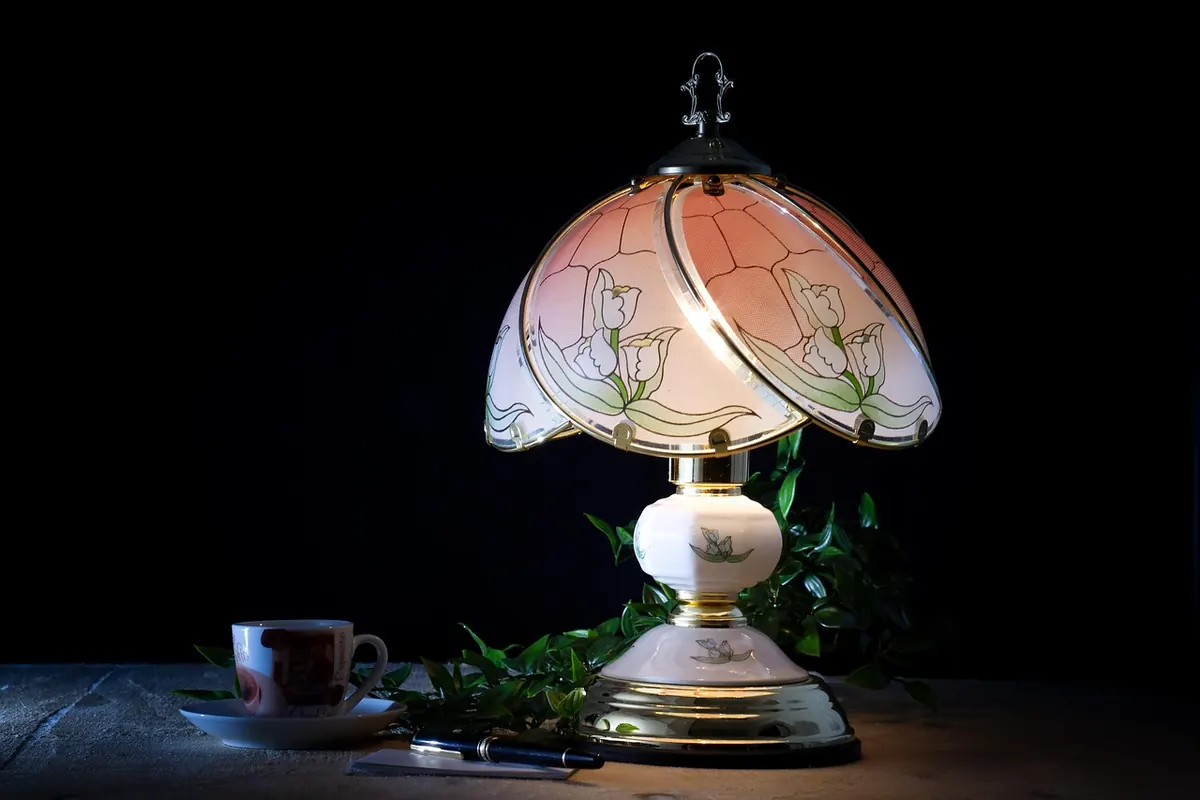
Lighting is decor, and it is the part most people get wrong. A desk lit only by a warm bulb in a dark corner feels lovely for ten minutes and tiring by mid-afternoon. One bright overhead light leaves your hands in shadow. A lamp placed on the same side as your writing hand does the same thing.
Layer it instead. General room light so the contrast between your screen and the walls is not extreme. A task lamp for the working area. A warmer accent light for the evening, if that is the mood you want. Put the task lamp on the opposite side to your writing hand, angle it so the light falls on your keyboard or paper rather than into your eyes, and check it does not throw a bright bar across the screen. Keep the shade below eye level when you are seated. If you are getting headaches or sore eyes, see an optician — rearranging a lamp will not fix that.
5. Decorating with other people’s jobs
An open tray holding unopened post. A styled stack of books you mean to read. A pretty jar full of cables. These look like decor in a photograph and behave like a to-do list in real life. Every glance is a reminder of something unfinished, which is precisely what you do not want when you are trying to start one thing properly.
Choose a single landing spot for paper, ideally with a lid or a drawer, somewhere out of sight but easy to reach, and clear it once a day. If a decorative object has become a storage problem, either give it a real job — one labelled drawer for cables — or empty it. Reminders work better written down than sitting on the desk surface.
6. Setting it once and never looking again
Decor that suited you while you were studying may not suit you now that you spend half the day on calls. A crowded desk is often just a desk that has not been re-tuned for the work you actually do. A short monthly audit sorts it out:
- What did I move out of the way this month? Those items are in the wrong place.
- What have I not touched? Those items can go.
- What do I reach for most? That belongs within easy reach and clearly visible.
- Is anything reflecting light into my eyes or onto the screen?
- Does the desk look calm from the doorway? If not, find the one thing causing it.
A desk that disappears
The aim is not a bare desk, and it is certainly not a desk styled for photographs. It is a desk that stops asking for your attention so you can give it to the work. Two minutes before you start each day is enough: put away whatever you used yesterday, clear the space directly in front of you so only the current task is there, and check that the light is not in your eyes.
Then judge it by the only measure that matters. Sit down, begin something, and notice whether your gaze stays where you put it. Good desk decor is not the part you admire. It is the part you forget.
Photo: geralt / Pixabay